
A Curious Discovery
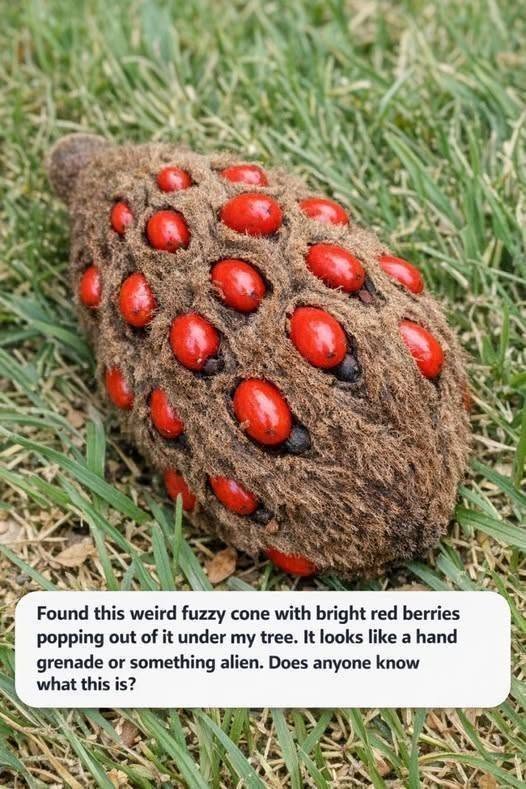
The object was about the size of my hand, resting quietly among fallen leaves. Its texture was unlike anything I’d seen before—almost velvety or fibrous. And those red “berries”? They weren’t loose or scattered. They seemed to grow directly out of the cone itself.
At that point, curiosity kicked in. Was it some kind of rare plant? A fungus? Or something I definitely shouldn’t be touching?
I snapped a few pictures and did what most people would do—I started searching.
Not What It Looks Like
It turns out, what I found wasn’t a pine cone at all.
It’s actually something known as a magnolia seed pod.
Magnolia produce these unusual cone-like structures after they flower. As the pod matures, it begins to open up, revealing bright red seeds inside. These seeds are often mistaken for berries because of their color and shape, but they’re not meant for eating.
The “fuzzy” texture I noticed? That’s completely normal. Magnolia seed pods often have a slightly hairy or textured surface, depending on the species.
Why the Bright Red?
The vivid red color isn’t random—it serves a purpose.
Birds are naturally attracted to bright colors, especially red. When they spot these seeds, they’ll often pick them out and carry them away, helping to disperse the seeds and grow new trees elsewhere. It’s nature’s clever way of ensuring survival.
Should You Be Concerned?
In most cases, no.
Magnolia seed pods are not dangerous just sitting in your yard. However, the seeds themselves are not meant for human consumption, and it’s always a good idea to keep pets or small children from putting unknown plant material in their mouths.
Otherwise, they’re simply part of the natural cycle of the tree.
A Reminder to Look Closer
What seemed strange at first turned out to be something completely natural—and actually pretty fascinating.
Moments like this are easy to overlook, but they’re reminders of how much there is to discover right outside our doors. Sometimes, the oddest things have the simplest explanations… once you know where to look.
So if you ever come across a fuzzy cone with bright red “berries” under a tree, don’t panic.
You might just be looking at one of nature’s more unusual designs.


