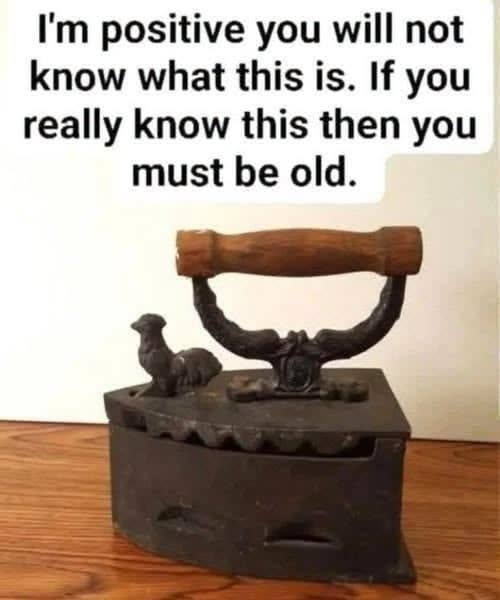
It had to become hot.
It had to retain heat.
It had to be heavy enough to press clothing effectively.
And, most importantly, it needed to be manageable enough for someone to move across fabric.
That is why the object in the photograph looks much heavier and more substantial than the lightweight irons most people use today.
Why Was It Called a “Box” Iron?
The name comes from its general shape.
Unlike some earlier flat irons, which were essentially solid pieces of metal with a handle, a box iron had a hollow interior or chamber.
That space was used to hold a heat source.
In this case, the heat source was charcoal.
The box-like construction allowed the user to carry the heat along with the iron instead of repeatedly placing a solid iron on a stove to heat it.
That made the tool more convenient than having to constantly return the iron to the fire.
However, it was still much more complicated to use than a modern electric iron.
The user had to manage the fuel, heat, smoke, and temperature.
There was no convenient dial.
There was no automatic shutoff.
There was no electrical cord.Clothing
And there certainly wasn’t a digital display telling you the exact temperature.
The person doing the ironing had to rely on experience.
How Did It Work?
The basic principle was surprisingly simple.
First, charcoal was heated until it was hot enough to produce substantial heat.
The hot charcoal was then placed inside the iron’s chamber.
The lid was closed, helping contain the fuel while allowing the necessary airflow.
As the charcoal burned or smoldered, it heated the surrounding metal.
Eventually, the bottom of the iron became hot.
The user could then place it against clothing and move it across the fabric.
The combination of heat, pressure, and movement helped smooth wrinkles.
The iron’s weight was actually an advantage.
Modern irons often rely heavily on controlled heat and steam.
A charcoal iron depended more on the combination of its hot metal surface and substantial weight.
The person using it had to know how much pressure to apply and how quickly to move.
It was an ordinary household skill that has largely disappeared.
It Wasn’t Simply a Heavy Piece of Metal
One of the most interesting details about charcoal irons is that their weight and shape weren’t accidental.
The heavy construction helped the iron maintain heat.