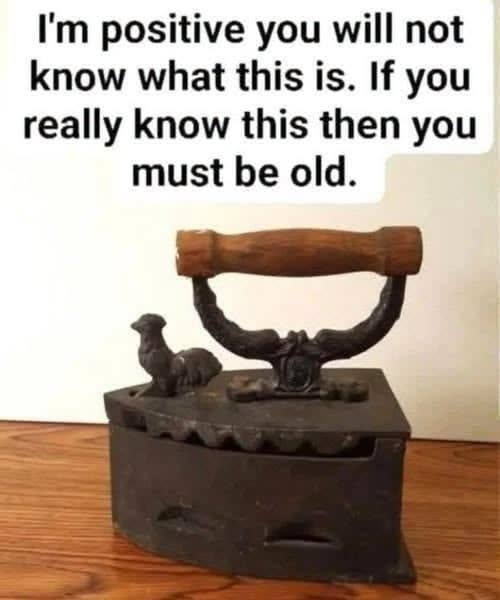
Metal absorbs and retains heat, and a substantial iron could stay warm for a considerable period.Photographic & Digital Arts
That meant the user didn’t necessarily have to heat it constantly.
But there was a trade-off.
A heavy iron could make ironing physically demanding.
Imagine pressing an entire family’s clothing using a tool made of thick metal while also keeping charcoal hot enough to maintain the correct temperature.
Laundry day was far more labor-intensive than it is now.
The person doing the ironing had to repeatedly lift and move a heavy object.
And that was only one step in the laundry process.
The Wooden Handle Had an Important Job
The wooden handle seen in the photograph wasn’t merely decorative.
It served an important practical purpose.
Wood is a poor conductor of heat compared with metal, making it much safer to hold than a metal handle attached directly to a hot iron.
The user could grip the wooden portion while moving the heated iron across clothing.
This is a detail that demonstrates how carefully these old tools were designed.
The makers had to think about how a person would interact with an object that could become extremely hot.
The handle needed to be sturdy enough to support the weight of the iron while remaining relatively comfortable to hold.
And because the tool was repeatedly heated and cooled, its materials had to withstand considerable stress.
What Is the Small Opening For?
The openings and vents on charcoal irons are another clue to their purpose.
A charcoal fire needs oxygen.
Without sufficient airflow, the fuel won’t burn effectively.
The design of charcoal irons therefore incorporated openings that allowed air to circulate.
Some openings also helped heat escape.
This was an important balancing act.
Too little airflow and the charcoal could struggle to remain hot.Metals & Mining
Too much airflow and the fuel could burn too quickly.